



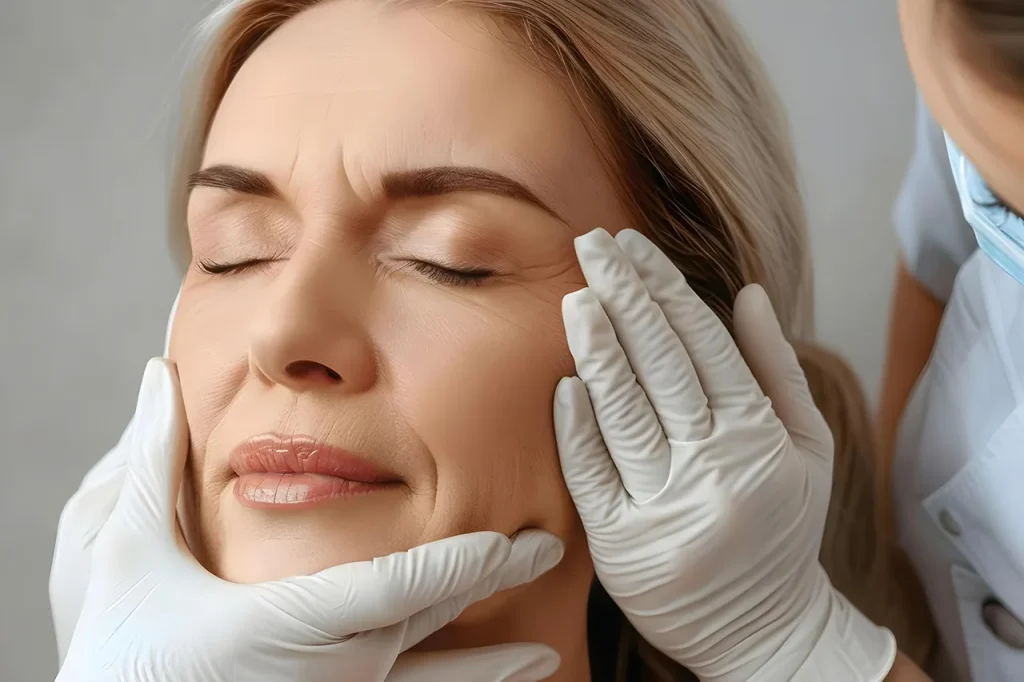
Over time, aging becomes noticeable for each of us. Unfortunately, it shows first in the most prominent place: the face. Even the best and most expensive creams can do little about it. The cause is natural skin aging. From the age of 25, it leads to a decrease in the body’s own elastin and collagen production, which often shows as sagging cheeks, drooping eyebrows, wrinkles or blurred jaw contours.
When this outward appearance no longer matches a youthful outlook on life, people often come to my practice in Frankfurt. Of course, many patients do not arrive unprepared. Most have read up online about various treatment methods such as the facelift before their consultation. What often causes confusion, however, are the many different terms such as mini, deep plane or SMAS facelift. Understandably, the question frequently arises as to which procedure is the right one.
My short answer: It depends. Among other things, on how far skin aging has progressed in the patient. And, of course, on what goals they want to achieve. To give you some initial orientation, this article looks at the individual facelift operations in more detail and explains which variant is suitable for whom.
What is a facelift?
In plastic and aesthetic surgery, the facelift is used to make tired facial features that have become loose with age look more alert, fresher and younger again. The principle is simple to explain: The loose, excess skin and the tissue beneath it are permanently removed through fine incisions, which are placed as discreetly as possible in the temple area, in front of and behind the ears and/or along the hairline. The remaining skin and subcutaneous tissue are then fixed in their new position with fine sutures.
This proven procedure can rejuvenate the areas of the lower half of the face (cheek region, jawline, chin area) with very good results. If desired, the neck region can also be included in the operation. Depending on the extent of the facelift and the patient’s individual wishes, different variants are suitable.
The classic facelift
The classic facelift is still the gold standard of facial rejuvenation and the most comprehensive procedure. I recommend the full facelift to patients who come to my practice with large amounts of excess skin on the neck (“turkey neck”), markedly sagging cheeks and correspondingly deepened nasolabial folds, or pronounced jowls.
To restore a youthful appearance with these pronounced findings, a comprehensive and deeper tightening of the lower half of the face and the neck region is needed. The incisions are typically made along the hairline, in front of and behind the ears.
In the past, the classic facelift consisted only of tightening the facial skin. The results of this facial tightening were often rigid, looked mask-like and unnatural, and were also short-lived. In modern plastic and aesthetic surgery, the approach has therefore shifted to including the deeper tissue layers and the muscles in the facelift, in order to achieve significantly more natural and long-lasting results. These modern variants of the facelift are known as the SMAS facelift and the deep plane facelift.
SMAS facelift
SMAS stands for “Superficial Musculo-Aponeurotic System”. This is a stable layer of connective tissue and muscle that, put simply, forms the foundation of your face. Instead of only pulling your facial skin tight, as in the outdated facelift, in a SMAS facelift I include this deeper layer in the tightening.
In this modern procedure, I first separate the skin from the sagging SMAS layer and then the SMAS layer from the tissue beneath it. I then tighten the deep layer and fix it in its new position with very fine sutures. Finally, I carry out the same steps with the skin. Because of this special approach, the results of the operation look much more natural and, in our experience, last longer (approx. 10 years).
Deep plane facelift
In the deep plane facelift, my approach differs somewhat from the SMAS facelift: Instead of detaching the skin and the SMAS layer separately, I release them together directly from the supporting structures beneath. I can then move both and tighten the face without tension.
The deep plane facelift also delivers very natural and long-lasting results, even with pronounced laxity and deep wrinkles. Since the technique is very demanding, you should have it performed only by an experienced plastic and aesthetic surgeon.
The mini facelift
A gentle and less invasive alternative to the full facelift is the mini facelift (also called S-lift or mini lift). The healing phase is correspondingly shorter. I recommend the procedure above all to patients who are slowly noticing the first signs of skin aging but whose signs are not yet as pronounced as described above.
In most cases, the procedure is performed under twilight sedation or local anesthesia. The incisions required are significantly smaller and I place them in front of the ear or hidden in the hairline, so that the scars are barely visible later. In our experience, the mini facelift achieves a gentle and natural tightening of the lower face.
Classic facelift vs. mini facelift: a direct comparison
The following table shows the differences between the two methods at a glance:
|
Classic facelift |
Mini facelift |
|
|
Surgical technique |
Comprehensive tightening of skin and SMAS, deep plane technique if needed |
Gentle, more superficial tightening |
|
Treated regions |
Lower half of the face and neck |
Lower half of the face |
|
Incisions |
longer incisions extending behind the ears / into the hairline |
shorter incisions, usually extending to in front of the ears / hairline |
|
Anesthesia |
General anesthesia |
Local anesthesia + twilight sedation (or general anesthesia) |
|
Surgery duration |
approx. 3 to 5 hours |
approx. 1 to 2 hours |
|
Recovery time |
approx. 3 to 4 weeks |
approx. 1 to 2 weeks |
|
Sports |
after approx. 4 to 6 weeks |
after approx. 2 to 3 weeks |
|
Longevity |
approx. 10 years or more |
up to 5 years |
Mini or classic facelift: Which method is suitable for whom?
The mini facelift is particularly suitable for patients:
-
who are noticing the first fine lines and loose skin on their face.
-
who want to delay the progression of natural skin aging.
-
who want a very gentle refresh or rejuvenation of their face.
-
who decline an operation with general anesthesia and extensive surgical effort.
The SMAS or deep plane surgical method, on the other hand, is an option for patients:
-
whose inner, youthful self-image no longer matches their reflection.
-
who do not want to accept deep wrinkles and cheeks that have sunk with age.
-
who, for a pronounced rejuvenation, are also willing to accept a more extensive operation.
Schedule an appointment now and get non-binding advice from a specialist in plastic and aesthetic surgery
Are you interested in a mini facelift, or have you already had an operation whose result you were not satisfied with? As a specialist in plastic and aesthetic surgery, I am available to you with many years of expertise in lifting operations. I offer you:
-
specialist consultation with a thorough examination and analysis of your individual facial structure, so that I can give you a reliable recommendation.
-
individual treatment planning including a cost estimate in which all costs associated with your mini facelift or full facelift are listed transparently.
-
state-of-the-art operating room equipment at the affiliated clinic in Frankfurt for safe treatment and an optimal result you will be happy with for many years.
-
personal care from the first consultation through the planning of your procedure to aftercare. Of course, I am also available for questions later on.
Call now and schedule your appointment for a non-binding initial consultation.

Dr. Nichlos on Instagram & TikTok
Insights into everyday life at the practice, answers to frequently asked questions and useful information about plastic and aesthetic surgery: follow Dr. Nichlos so you do not miss anything.