




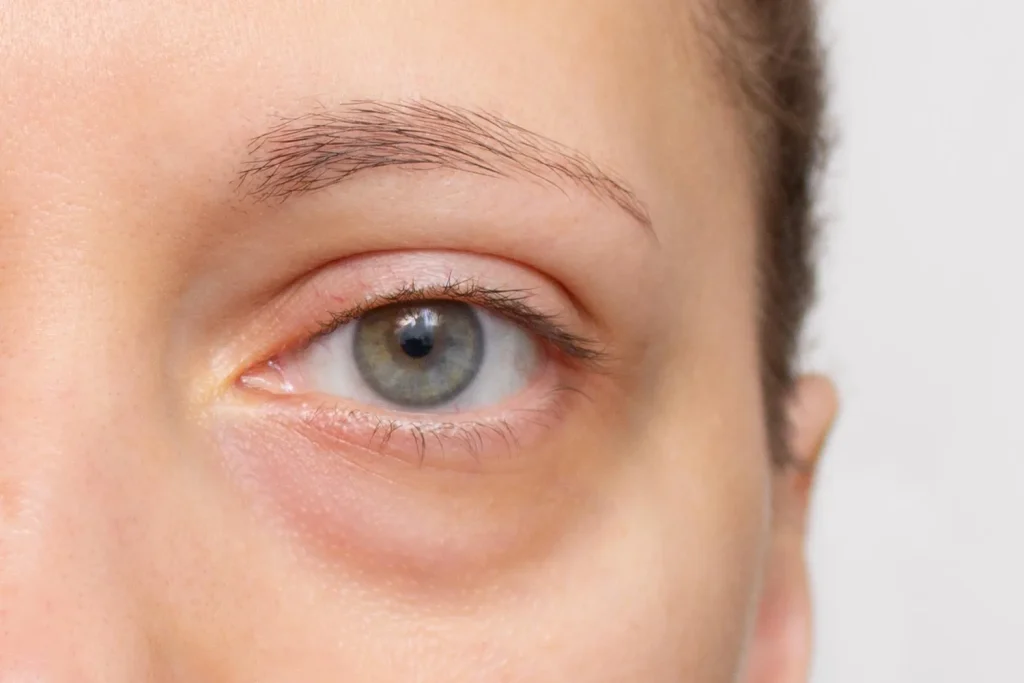
Under-eye bags are among the most common problems patients bring to me, because they make the face look tired and aged. Those affected have often tried everything to get rid of their under-eye bags, from expensive eye creams and serums to tips from social media to the famous cold spoon and grandma’s cucumber slices. In most cases without success. The reason is that what lies behind them is usually not swelling but tissue in the form of fat and skin, which does not simply recede or disappear overnight.
In this guide, I want to explain how under-eye bags develop, what you can do about them yourself, which “tips” you should not try, and how this mostly purely cosmetic problem can be corrected surgically with a lower eyelid lift. At my practice in Frankfurt am Main, I am also happy to advise you in person.
What are under-eye bags, actually?
Despite what the name suggests, under-eye bags have nothing to do with the tear apparatus. The anatomical lacrimal sac (Saccus lacrimalis) is relatively small, sits at the inner corner of the eye and has the task of draining tear fluid.
What is commonly called under-eye bags is protruding fat and slack skin. The eye socket contains fat pads that protect the eyeball. This layer is held back by a very fine, taut connective tissue membrane, the so-called septum orbitale. As with the skin, the membrane loses tension with increasing age, so the fat pushes forward and finally bulges out under the lower eyelid. At the same time, the skin under the eyes becomes slack. Together, the two form the under-eye bags. Retained fluid can make them more pronounced.
Where do under-eye bags come from?
The most important factor, as so often, is genes. They determine how stable the connective tissue is and how voluminous the fat pads around the eyes are. If your parents had under-eye bags, you are more likely to get them at some point too. The second factor is age. Over the years, the skin becomes thinner and loses collagen. The ring muscle around the eye (Musculus orbicularis oculi) also loses tension, the septum orbitale becomes slack and fat pushes forward.
Third, cheek fat sinks with age. This makes the groove between the lower eyelid and cheek look even deeper and the bulge stand out even more clearly. If you naturally have little subcutaneous fat in the face, you may see your under-eye bags earlier because there is hardly any tissue to conceal the bulge.
Finally, lymphatic drainage plays a role, though differently than often claimed. At night it works more slowly, which is why swelling is strongest in the morning. Alcohol and nicotine as well as salt in the evening and lack of sleep intensify this fluid retention. True under-eye bags do not arise from it, however. At most, they become more visible for a few hours.
Is it possible to prevent under-eye bags?
Only to a limited extent. Whether the fat under the eyes bulges forward is, as mentioned, largely genetic. You can only influence how early and how clearly the under-eye bags become visible. To do so, you should pay attention to a healthy lifestyle, that is:
- Consistent sun protection (UV radiation breaks down collagen)
- Avoiding nicotine (smoking accelerates collagen breakdown)
- Enough sleep with the head slightly elevated (relieves the lymphatic system)
- Careful handling of the eyelid skin (little rubbing, gentle makeup removal)
- Moderate alcohol consumption (alcohol binds water in the tissue)
You should not expect miracles from this, however. Once a bulge appears, it can no longer be eliminated by these measures.
What is the difference between under-eye bags, dark circles and eyelid swelling?
Usually all three are lumped together. Their causes differ fundamentally, however, and so does the answer to the question of what helps against the unwanted changes.
- Under-eye bags are protruding fat, slack skin or both together. The bulge is clearly visible, can be felt and remains all day.
- Dark circles are dark discolorations and shadows under the eyes. They usually result from volume loss at the transition to the cheek, which can often be compensated with wrinkle treatment with hyaluronic acid. The skin itself is not discolored.
- Eyelid swelling is an accumulation of fluid, for example from too much salt in the evening or an unhealthy lifestyle. As a rule, the swelling subsides over the course of the day.
A simple rule of thumb: what changes over the day is usually pure fluid. What stays permanently is fat, slack skin or a combination of both.
When do I need to see a doctor about my under-eye bags?
If you have had under-eye bags for years and they have hardly changed, there is no reason to see a doctor. It is different if the swelling around your eyes appears suddenly or on one side only, or if your eyes noticeably protrude. In that case, please see your family doctor or ophthalmologist promptly for a checkup. He or she can rule out internal diseases.
The symptoms mentioned can be hiding, for example, an underactive thyroid. This makes the connective tissue in your body swell, including the area under the eyes known as under-eye bags. Graves’ disease is also possible. In this autoimmune disease, the eyeballs protrude from the eye sockets. Kidney disease or heart failure should also be considered. Comparatively harmless allergies are also possible causes.
Are there effective home remedies for under-eye bags?
No home remedy can do anything against true under-eye bags, that is, fat that bulges forward due to age or weak connective tissue, and slack skin. What the cucumber slices or quark compresses already recommended by grandma achieve is cooling. Cold briefly narrows the blood vessels under the eye and slightly reduces morning swelling caused by fluid retained in the tissue.
Caffeine has a similar vessel-constricting effect. That is why it is found in many serums offered online and in drugstores for under-eye bags. Here, too, the smoothing effect lasts for a few hours at most. Caffeine has no lasting effect on the protruding fatty tissue and the firmness of the skin, so the eye area looks the same as before after a few hours.
Supposed “tips” from social media are of little help and sometimes even dangerous. One example is the alleged insider tip of using hemorrhoid ointment against under-eye bags. The cream is supposed to reduce swelling, but it belongs in the intimate area and by no means near the eyes. In the worst case, it can lead to severe eye irritation or inflammation.
Please also avoid:
- taking diuretic tablets
- other unknown ointments and tablets from dubious sources
- questionable insider tips on social media such as Instagram or TikTok
How can under-eye bags be removed?
The only effective treatment option is a surgical procedure, the so-called lower eyelid lift. From a medical point of view, it is only rarely necessary. That is why I recommend an operation only if you suffer from these consequences of the natural aging process and want a fresher appearance. I offer under-eye bag surgery in two variants, that is, with two approaches:
Through the conjunctiva (transconjunctival)
With this variant, I make an incision on the inside of the lower eyelid. Through it I reach the protruding fat and either reduce it or move it into the tear trough. The nice thing is that this operation leaves no visible scar and the eyelid tension is preserved. However, the skin cannot be tightened with this method, which is why it is better suited to younger patients who do not yet have a significant excess of skin.
Along the lash line (transcutaneous)
With this approach, I make a fine incision along the lashes. Through it I remove excess skin and fat. If needed, I tighten the muscle and move fat into the tear trough. Careful scar care in the weeks afterward ensures that the fine suture heals inconspicuously.
The modern approach is to reposition the fat rather than remove it. This way, the fatty tissue smooths the transition from the eyes to the cheek and the eye socket does not look sunken.
If you find the shadows under the eyes bothersome rather than the bulge, injecting autologous fat is an option. I have two preparations available for this:
- Microfat is specially reduced autologous fat that improves volume deficits and thereby softens shadows.
- Nanofat, by contrast, does not add volume but has exclusively regenerative properties and improves the quality of the thin eyelid skin.
Dr. Nichlos on Instagram & TikTok
Insights into everyday life at the practice, answers to frequently asked questions and useful information about plastic and aesthetic surgery: follow Dr. Nichlos so you do not miss anything.