





Every operation leaves scars behind, and despite all precautions they cannot be avoided. With good, consistent scar care, however, you can positively influence how the scars look later and prevent symptoms such as itching and a feeling of tightness. But what does the right care look like?
As a specialist in plastic and aesthetic surgery, I consider scar care part of every surgical procedure and important for an aesthetic result. Below, I would like to explain how you can support tissue regeneration with ointments and massage, when it is best to start, and what options exist for improving scars that have not healed well.
How a scar forms and why the first months count
When the skin is cut during an operation, for example, the body forms replacement tissue at that spot to close the injury again. This scar tissue, however, consists of connective tissue, so unlike normal skin it lacks features such as blood vessels, sweat glands, pigment cells and hair.
The healing process takes place in three phases. In the first one to three weeks, the wound cleans itself and closes. After that, in the so-called granulation phase or proliferation phase, new tissue forms over several weeks to months and fills the defect. During this phase the fresh scar is often still strongly reddened and stands out clearly from the surrounding skin. Last comes the remodeling phase, also called the differentiation phase, in which the collagen fibers mature.
Full maturation can take one to two years. For how the scar looks later, however, the first weeks and months are decisive. During this time the scar may appear stable on the surface, but it is not yet. Mechanical stress that comes too early or is too strong can easily damage the still fragile fiber structure. The result is often a wide or raised scar. To achieve a pale, soft scar level with the skin, the right scar care is important.
What is meant by scar care and what is it aimed at?
Scar care can influence how scars look later and also how mobile they are once they have fully matured. It also helps relieve accompanying symptoms such as itching and pain. What good scar care involves depends on several factors, such as the location and size of the scars, for example whether it is a relatively small scar after a facelift or a larger scar after a tummy tuck.
In most cases, scar care involves the use of special creams, gels, patches and dressings or compression. The latter plays an important role, for example, with very large scars. Targeted massage, the consistent application of sun protection in the form of sunscreen with a high sun protection factor, and special treatments such as microneedling can also support scar healing and so help produce a flat, barely noticeable scar.
Good scar care can:
- speed up scar healing
- improve the mobility of the scar
- relieve pain, itching and a feeling of tightness
- make scars more elastic and less visible
- prevent complications such as infections
What does good scar care look like?
The most important thing is patience. Scars need time to heal and fade. The tips I recommend below help, but they cannot speed up wound healing itself or turn a still fairly fresh, reddened scar into an invisible one overnight. It is also completely normal for a freshly sutured wound to look less noticeable than the reddened, thick scar that follows once it has healed. This is not a deterioration and does not call for scar revision.
Giving up smoking
In fact, you can set the course for good scar development even before an operation by avoiding nicotine for several weeks beforehand. This improves oxygen supply and lowers the risk of a wound healing disorder, which in turn affects scar formation.
Scar massage
The body wants to close wounds as quickly as possible and therefore lets collagen in without any order. A firm, matted network can form as a result. With regular massage (only after the wound has fully closed), you can loosen the tissue. Kneading stimulates the metabolism, promotes circulation and makes the skin softer. As a side effect, the feeling of tightness eases.
You can knead the scar quite firmly. For example, take it between your thumb and index finger and roll it back and forth. Always for a few minutes and several times a day. If you like, I am also happy to show you how best to proceed with your particular scar. You can combine scar massage with creams and ointments.
Creams, ointments and patches
By applying care products such as silicone (as a scar gel), scar ointments (e.g., with allantoin) or special scar patches from the pharmacy, you can protect the tissue well from drying out and keep it supple in the long term. The aim is to relieve acute redness and itching, but also to prevent hardening. Data from various studies show positive effects on the later thickness and color of the scar. However, a lot of perseverance is needed for it to work. It is best to apply cream several times a day over a period of months.
Sun protection
The skin protects itself from UV radiation by forming color pigments (melanin) in the melanocytes. Scar tissue cannot do this. Because melanin is missing, the risk of sunburn and of developing skin cancer is extremely high. Hyperpigmentation (permanent discoloration) can also occur at the edge of the scar, so that the scar later stands out from the surrounding skin. You can prevent this by applying sunscreen (SPF 50+) or wearing long clothing.
Compression therapy
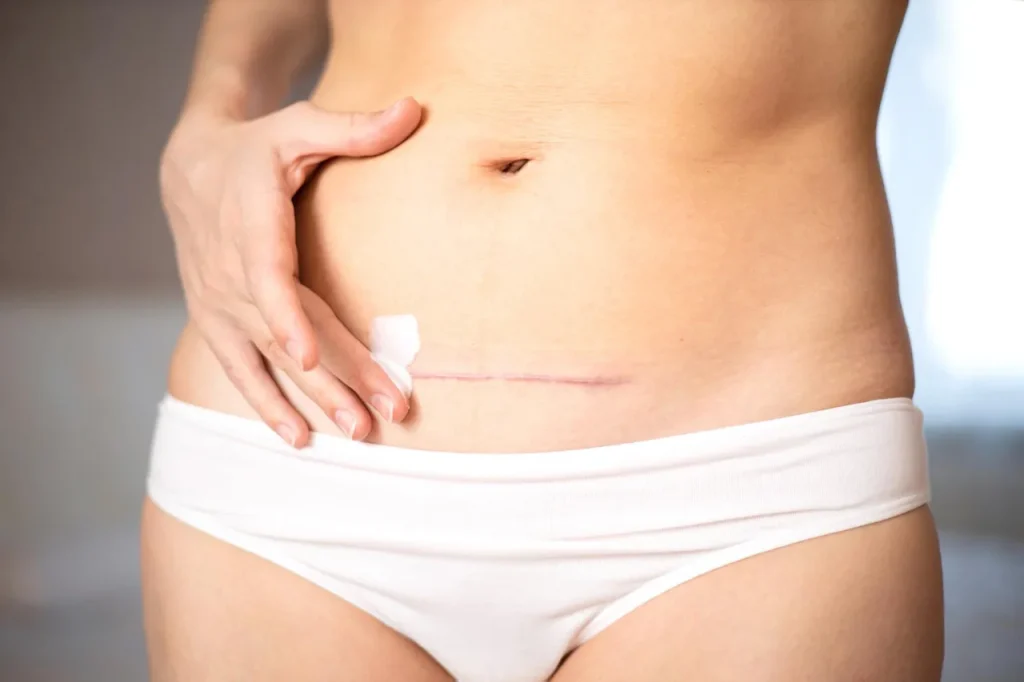
After body contouring procedures such as a tummy tuck, compression is used as support. The even pressure over a large area keeps the scar softer and more flexible, prevents it from overgrowing and keeps it more pliable later, so that restrictions in movement occur only rarely. For this it is important to wear the compression consistently, usually around the clock.
Good to know: You can also turn to home remedies, such as olive oil or clove oil. Aloe vera and ointments with onion extract can sometimes help as well. However, you should avoid vinegar and similar irritating substances as well as unknown ointments from the internet.
The most common mistake in scar care: too early and too much
After a procedure, many people want to do something right away to influence scar formation as positively as possible. This is understandable, but it is exactly what can impair wound healing and lead to undesirable results. That is why I generally advise my patients not to apply any care products to wounds that have not yet healed or are still weeping.
I recommend starting scar care only once the wound is completely closed, there are no more scabs or weeping areas, and there are no signs of inflammation left. After an operation, this is usually reached around the time of suture removal. Until then, simple basic care that keeps the skin supple may be sufficient.
What if the scar does not heal as hoped after all?
The vast majority of scars after operations heal without any problems with good scar care, keep fading and cause no trouble. Sometimes, however, because of a predisposition or mistakes in care, tissue overgrows, which in medicine is called a hypertrophic scar (thick, raised scar) or keloid (tissue growth beyond the wound).
The good news is that there are treatment options in such cases. The claim that nothing can be done about scars after a certain time is wrong. There are always ways to improve an unattractive scar by smoothing it or injecting certain active substances. The following have proven effective:
- Cortisone injection: slows the excessive tissue growth
- Laser treatment: softens hardening and smooths irregularities
- Cold treatments (cryotherapy): freezes the scar tissue
In some cases, compression therapy can also bring improvement. Sometimes, however, only a surgical correction helps. In my practice for plastic and aesthetic surgery in Frankfurt, I use it, for example, to reduce very raised scars or to reposition scars and take tension off them.
If you have a scar (after an operation or large acne scars as well) that has not healed as desired or is causing you problems, you are welcome to schedule a no-obligation consultation. Simply call us or use the online booking.
Dr. Nichlos on Instagram & TikTok
Insights into everyday life at the practice, answers to frequently asked questions and useful information about plastic and aesthetic surgery: follow Dr. Nichlos so you do not miss anything.