






The demand for aesthetic treatments has grown rapidly in recent years. Unfortunately, so has the number of disreputable and insufficiently qualified providers who want to profit from these procedures. To avoid taking unnecessary risks and to find a plastic surgeon who carries out your wishes professionally, you should look closely when choosing a doctor. As a specialist in plastic and aesthetic surgery, I will explain to you first-hand how to recognize quality.
Look for the specialist title
Let’s start with the biggest misunderstanding. Many people still think that the label “cosmetic surgeon” automatically stands for a surgeon specially trained in aesthetic procedures. That is definitely not the case. In Germany, the term is not protected, so any doctor may use it. Even a dentist or a general practitioner without surgical training may, in theory, put it on the sign outside the practice. The same applies to titles such as:
- Cosmetic surgeon
- Aesthetic surgeon
- Beauty doc
They all sound important, but they are not protected and say nothing about the doctor’s training or specialty training. The only reliable indicator when looking for a plastic surgeon is the protected specialist title “Plastic and Aesthetic Surgery” (Facharzt für Plastische und Ästhetische Chirurgie). I may only use it after completing six years of specialty training following medical school and passing the specialist examination. As a prospective specialist in plastic surgery, I had to perform well over 600 procedures during this time, independently and under the guidance of experienced colleagues.
The breadth of the field shows how comprehensive it is. Plastic surgery rests on four pillars:
- Aesthetic surgery
- Reconstructive surgery
- Burn surgery
- Hand surgery
A doctor with the title of specialist in plastic surgery therefore masters a broad range of treatments, from reconstruction after accidents to aesthetic procedures.
Check memberships in professional societies
Memberships in so-called professional societies are also a good quality indicator when looking for a plastic surgeon. At the international level, these are ISAPS and EASAPS; in Germany, DGPRÄC, DGÄPC and VDÄPC.
The societies admit only specialists with the corresponding title who have already been operating independently for several years and have committed to a code of ethics. On their websites you will find member directories, so you can quickly and free of charge check whether a doctor is a member. You can also use the directories to look for reputable specialists in plastic and aesthetic surgery.
Ask these seven questions in the consultation
In the conversation with the treating doctor, you may ask anything that is on your mind. After all, it is your body and your money. Every reputable specialist even expects critical questions and is happy to answer them in detail. For me, this is always a sign that my patients have already looked into the topic thoroughly beforehand and are not coming to me on a whim because, for example, they want an operation because of a trend.
If a doctor reacts to your questions with annoyance or evasiveness, or you have a bad feeling for any other reason, it is better to keep looking. It is best to prepare for the conversation by making a few notes. In our experience, patients ask only half of the questions they actually wanted to ask because of nervousness. Important questions are:
Are you a specialist in plastic and aesthetic surgery?
Feel free to have the title explained to you in detail. If you are unsure or simply want to be certain, you can verify the title at any time through the state medical association. Very important: Certificates or weekend courses are no substitute for specialist training.
How often have you performed this procedure?
A specialist in plastic and aesthetic surgery covers a broad range. However, there is a difference between ability and real routine. If a doctor performs breast augmentation every week, he knows the pitfalls better than someone who has it on the surgery schedule only once a month.
Can you show me before and after photos of your patients?
As the saying goes, a picture is worth a thousand words. In the consultation, ask for before and after photos of patients with a starting situation similar to yours. A reputable doctor will show you natural photos that are not obviously heavily edited.
What does the procedure cost and what is included?
Cost transparency is an important quality indicator. In the consultation, ask for a written cost plan. Every reputable specialist in plastic surgery will prepare a detailed overview for you that includes everything from the fee to the clinic and anesthesia to aftercare.
Other useful questions you should ask:
- What risks are there and how often do they occur?
- Is anesthesia necessary and is it administered by an anesthesiologist?
- What does aftercare look like following the operation?
Assess social media correctly
I am active on social media myself, where I give insights into my everyday work as a plastic surgeon and explain common procedures. Patients repeatedly come to my practice, take their smartphone out of their pocket, show me social media photos of, for example, breast surgery, and say they want to look exactly like that.
Unfortunately, the photos are increasingly edited with filters or AI and create false expectations. I am in favor of strictly labeling such edited images, and I therefore deliberately refrain from using them. But that is not the only problem. The photos and videos often show people with a completely different anatomy. My task as a reputable specialist is then to tell you honestly what is realistically possible and what is not, and to find a solution that suits your body.
Be skeptical, therefore, if you show a doctor a photo from social media and he immediately tells you that he can achieve exactly that for you. A healthy mistrust of social media in general can’t hurt either, especially today, when photos and videos can be altered with AI almost undetectably and without much expertise.
Avoid cheap lure offers from abroad
Cosmetic surgery with a vacation included. That sounds tempting, of course. Providers from Turkey in particular advertise such offers on social media. Even if the surgery goes well, the problem is often that you have no point of contact after you return to Germany.
Who removes the sutures, and who takes care of you if complications do arise? In the end, it is a German doctor who has to help. I have had such cases myself. For this reason, do without surgery abroad unless pre-operative and post-operative care are ensured by the same surgeon.
Look at online reviews
Patient reviews give you initial orientation when looking for a specialist. However, you should not base your decision solely on a flawless five-star rating. Pay attention to what the patients write.
Do they only write about short waiting times and low prices, or is there also solid information about the medical history, aftercare and general satisfaction with the result? If everything sounds too smooth, you should be suspicious. Reviews can be bought and bad reviews deleted.
Take your time with your decision
Now you know what to look for. Please still take your time searching for a doctor. Check the qualifications calmly, ask your questions and, very importantly, always trust your gut feeling. If you do not feel 100% comfortable or taken seriously, it is better to keep looking a little longer or get a second opinion. After all, it is about your health, and it is irreplaceable.
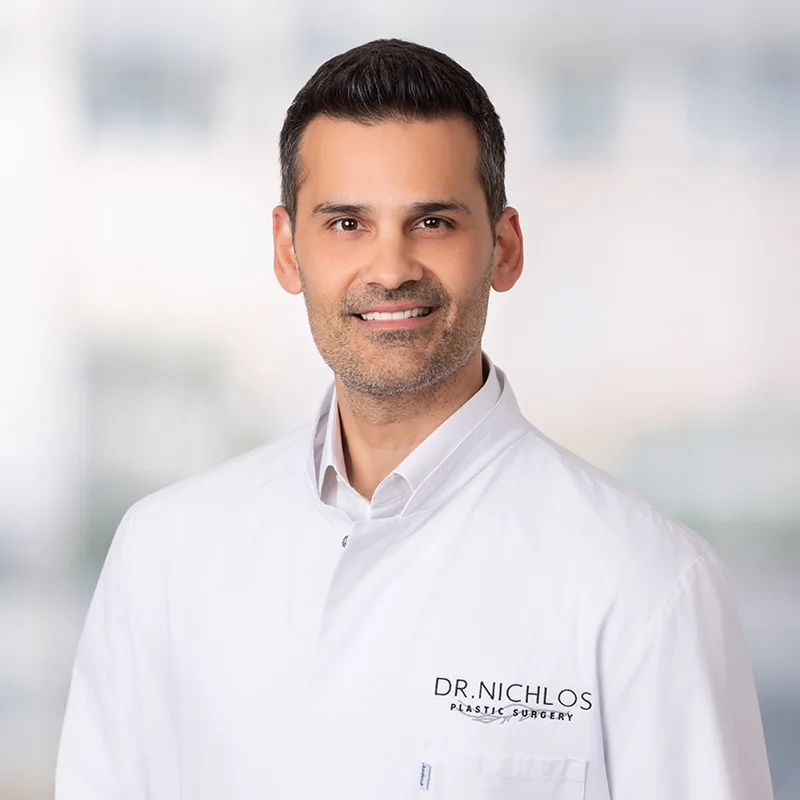
You can find more about Dr. Nichlos and his qualifications on the page About Dr. Nichlos.


Dr. Nichlos on Instagram & TikTok
Insights into everyday life at the practice, answers to frequently asked questions and useful information about plastic and aesthetic surgery: follow Dr. Nichlos so you do not miss anything.