



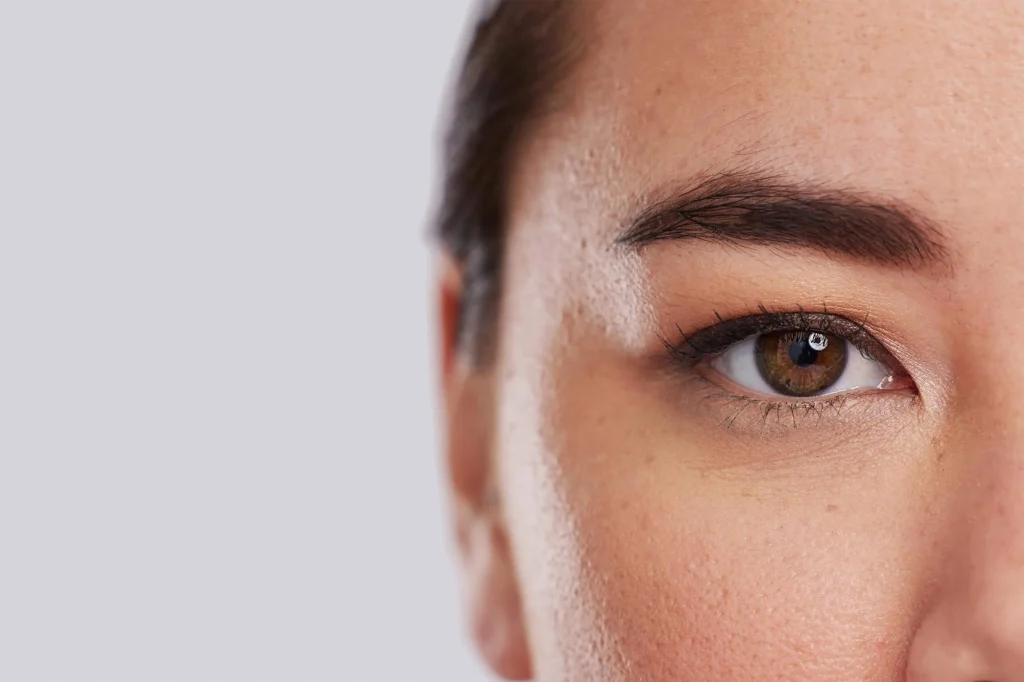
Have you noticed a clear excess of skin on your upper eyelids? A typical sign of hooded eyelids. The phenomenon affects many women and men, both at a young age and later in life. In most cases, the slack eyelid skin is a purely cosmetic problem that makes your expression look tired and worn out. When pronounced, however, it can also restrict your field of vision and cause irritation and even inflammation. I will tell you how hooded eyelids develop, what you can do to prevent them, and how they can be corrected surgically.
What are hooded eyelids?
“Hooded eyelids” is the colloquial term for what is medically called dermatochalasis. It refers to excess, slack skin on the upper eyelid that, due to gravity, folds over the natural eyelid crease. Characteristic of hooded eyelids is that they make the face look tired, sometimes also grumpy and irritated, make the eyes look smaller, and often occur on both upper eyelids.
How do drooping eyelids develop?
As a rule, the natural aging process is the reason for hooded eyelids. Through the gradual loss of collagen and elastin, the connective tissue loses its elasticity. In addition, the supporting subcutaneous fatty tissue is broken down. As a result, the skin is stretched, becomes noticeably thinner, and sags further and further. In addition, there are factors that intensify or accelerate the process:
- smoking/nicotine and alcohol
- intense sun exposure
- lack of sleep and chronic stress
- a high-salt diet with water retention
Hooded eyelids are by no means a topic that only affects older people, however. In my practice, I regularly see patients in their mid-twenties as well. The reason here is almost always genetic. Often there is an inherited weakness of the connective tissue, or the eyelid crease sits very low.
There are also cases in which it is not the eyelid but the eyebrow that is responsible for the sagging skin. If the eyebrow sinks over the years, the skin is pushed downward and forms a fold on the upper eyelid. In such cases, a hooded eyelid surgery alone would be the wrong solution. That is why I always look at the entire eye area before I recommend a treatment.
Not every drooping eyelid is a hooded eyelid
As mentioned, hooded eyelids result from excess skin. To be distinguished from this is true drooping of the eyelid (medically ptosis). Here, a muscle weakness causes the upper eyelid to sink. The results look similar but require different procedures. For this reason, a careful examination by a specialist is so important.
When hooded eyelids become a medical problem
As long as the gaze merely looks tired, hooded eyelids are a purely aesthetic matter and do not necessarily have to be treated. They only become a medical problem when the excess skin sags so far that it narrows the field of vision. This is often noticeable first when looking up and to the side, and later in everyday life when driving or reading.
Many affected people unconsciously raise their eyebrows to see better. This, however, puts constant strain on the forehead muscles and can lead to tension headaches. At first, these are often not connected with the hooded eyelids at all. Many of my patients are surprised when I tell them that their headaches are probably not caused by stress or screen work, but by compensating for the restricted vision.
By the way: How much the field of vision is restricted can be determined with a visual field test at the eye doctor. The examination is painless and immediately shows which areas may no longer be perceived at all, unconsciously.
Be careful with suddenly drooping eyelids
Changes with hooded eyelids develop slowly over years. If an eyelid, on the other hand, suddenly droops within minutes or hours, it has nothing to do with skin slackening and can be a warning sign of an acutely life-threatening condition such as a stroke. In such a case, please do not wait and call the emergency doctor immediately.
What you can do yourself about slack eyelids
Once the skin on the upper eyelid has become slack, neither expensive eye creams nor eyelid exercises from the internet will tighten it again. At least not permanently. Creams and other supposed miracle remedies reach at most the upper layers of the skin and not the stretched connective tissue. Exercises also achieve little, as they only train the muscles but do not tighten the slack skin.
You can, however, influence how quickly hooded eyelids form. I named the factors that accelerate the process above. If you get these under control early, you ideally push back the slackening of the tissue by years. Here are a few more tips:
- Use sunscreen with a high sun protection factor. Sunglasses with UV protection can’t hurt either. UV radiation is the main cause of premature skin aging.
- Start eyelid care early. Active ingredients such as retinol are well suited. They stimulate collagen formation and strengthen the connective tissue. You should not expect miracles, though.
- Vitamin C and hyaluronic acid also have a measurable effect on firmness and moisture supply and can help keep the skin in shape longer.
If you have a corresponding predisposition, however, even the best care cannot prevent the skin from sagging at some point and you from developing hooded eyelids. But it can’t hurt either.
By the way: Cooling the eyes with, for example, a cold spoon only helps against swelling and makes the eye area look fresher for a short time. It does not remove the actual cause of the hooded eyelids.
What treatment methods are there for hooded eyelids?
The most effective is the upper eyelid lift, also called blepharoplasty. It is one of the most common procedures in plastic surgery and provides lasting tightening. In the operation, the surgeon removes excess skin and fatty tissue. Usually on an outpatient basis and under local anesthesia.
There are also non-surgical methods such as the plasma pen or laser treatment. The plasma pen, at least, quickly reaches its limits with pronounced hooded eyelids. The laser, too, is better suited to mild findings. For removing hooded eyelids, I prefer the classic surgical method, because in my opinion only that achieves a lasting and satisfying result.
How the operation works at my practice, what result can be achieved with it, and what else you should know about this treatment option, you can read in detail on my service page on the upper eyelid lift.
Does insurance pay for treating hooded eyelids?
For purely aesthetically motivated treatments, unfortunately not. For insurers to consider coverage at all, in our experience there must already be a severe restriction of the visual field or chronic eye irritation. For a request for cost coverage, you need:
- a medical certificate confirming the medical necessity
- a visual field test that clearly documents the restriction of vision
- photos of the slack eyelids from several angles
From experience I can say that insurers examine every individual case closely and sometimes reject applications where you would have firmly counted on reimbursement. The opposite is just as possible. It is worth a try. At my practice in Frankfurt, I treat privately insured patients as well as self-pay patients and am glad to discuss the options with you personally.

Dr. Nichlos on Instagram & TikTok
Insights into everyday life at the practice, answers to frequently asked questions and useful information about plastic and aesthetic surgery: follow Dr. Nichlos so you do not miss anything.